


At first blush, Tazria-Metzora is a double parasha about illness. It includes a detailed description of this enigmatic disease called tzara’at. similar to, but not the same, as leprosy. But the Rabbis suggest the whole detailed description of tzara’at is not about only about disease but discourse, malicious speech.
Where does this idea come from, this notion that a skin ailment can be attributed to slander? Well, it’s not in Tazria or Metzora. It comes, eisegetically I would say, from two sources. I’ll take them in reverse chronological order. The first is from B’ha’alot’kha in the book of Numbers when Miriam and Aaron come to Moses with a complaint: “Vat’daber Miriam v’Aharon b’Moshe al odot ha’isha hakushit…, Miriam and Aaron spoke against Moses because of the Cushite woman he had married…” (12:1). The midrashic tradition assumes the affliction of tza’arat that follows nine verses later is a direct result of this lashon hara which literally means the “evil tongue.” But, while plausible, it’s not necessarily the most likely explanation. First of all, the Torah is explicit that Miriam, and not Aaron, is affected – but both of them spoke, yes? Disparity aside, perhaps Miriam was punished for challenging Moses publicly.
A contemporary rabbi (Norman Cohen) suggests it could be a punishment for racism. Miriam doesn’t like the darkness of Moses’ Cushite wife, so God turns her excessively white – measure for measure, midah k’neged midah. But that’s almost certainly incorrect. Dark skin is no liability in the ancient Near East, and while prejudices of various kinds have existed as long as humanity itself, anti-Black racism as we understand it today is hundreds not thousands of years old.
Rashi, for his part, imagines them critiquing him for abandoning his wife, Tzipora! Even the translation “against” Moses is an interpretation; while the preposition “b’moshe” is atypical, it could still mean they spoke “to” Moses. The point is, there are any number of possible causes to Miriam’s ailment – and even if we take the text at face value and assume there is a cause at all, the conspicuous absence of any etiology in numerous chapters of Tazria or Metzora makes the Numbers case the exception, not the rule!
The second example connecting this disease with harmful speech comes earlier in the book of Exodus (Ch. 4) and is even more tenuous. Essentially, God gives Moshe two magic tricks to impress Pharaoh: transfiguring his staff into a snake and giving himself tza’arat before curing it just as quickly. The midrash says the skin ailment was a result of Moses’ questioning the Holy One’s command to go before Pharaoh, but there’s scant evidence for such a claim. For these reasons, though, our Sages say that the term metzora, one afflicted with this leprous condition, is an acronym for motzi (shem) ra, one who brings forth a bad name, one who gossips.
Tenuous though this may be, the wonder of Torah is that it is always revealing itself to us in new ways. My teacher, Prof. Walter Herzberg, would say perhaps the most important thing to keep an eye out for when studying Torah is “perspective.” Sometimes to really understand a text we need to look at things from a different angle. It’s April, so perhaps a baseball story is called for:
There’s a young boy with a bat in hand, practicing his hitting by tossing a baseball into the air and swinging at it. He does this once, tosses it up, takes a good swing and, swish, misses the ball entirely. He does the same thing a second time. Swings and misses. The third time, he tosses the ball in the air, and carefully keeping his eye on the ball, he watches it go up… and as it’s coming down he swings cleanly across his body and… woosh. Misses it again. “Strike three,” says the kid to himself, “I had no idea I was such a good pitcher!”
So, considering this alternate perspective, here’s another way of thinking about tzara’at. Since the Torah is clear in our double parasha that this disease has no cause, nor any discernable cure, perhaps the Rabbis are not so fanciful in viewing it less as a treatise on the nature of disease but as a powerful metaphor for the nature of speech. In what ways do gossip, slander, lashon hara, manifest like a disease? How do hurtful words corrode a person? How do they leave us feeling ugly – disfigured and vulnerable? How do they force us to live in partial or even total isolation? Aren’t they, literally, communicable?
The Torah says, “lo telekh rachil b’amekha. Lo ta’amod al dam rei’ekha…, Do not go as a talebearer among your people, do not stand idly by the blood of your neighbor” (Lev. 19:16). And tradition suggests the two clauses in the verse are not unrelated. Speech can kill, sometimes literally – as in Nazi Germany or Stalin’s Russia where the tale bearing of neighbors lead to catastrophic loss of life. And in this internet age of social media our society provides vehicles upon vehicles for defamation, disinformation – or perhaps violent ICE dragnets. How many stories have we heard about kids who are mercilessly bullied, resorting, God forbid, to acts of self-harm?
But the arrested heart is only one version of death. Evil and destructive speech can also undo a life in other ways – by obliterating a friendship, unmaking a marriage, or ruining a career. Rabbi Israel Salanter, founder of the Mussar Movement says, “If you say of a rabbi that he does not have a good voice and of a cantor that he is not a scholar, you are a gossip. But if you say of a rabbi that he is no scholar and of a cantor that he has no voice – you are a murderer.” But think about it, inasmuch as death is a permanently altered state, the victim of slander or gossip is deprived of the life she once had. She may be born again, but it will be, on some level, Phoenix-like, out of ashes. The metzora, having no appearance of malady, may re-enter the camp. But the man who enters will not be identical to the one who left. The world is filled with human beings sporting scars invisible to the naked eye.
And, as the Talmud points out, it’s not only the slandered who is culpable. The bystander, too, bears some responsibility, perhaps a lot. “One who listens to l’shon hara is worse than one who recites it” we read in Masechet Pesahim (118a). For, as the verse in Leviticus makes clear, to stand idly by our neighbor’s blood is to condone, even support, and perhaps aid and abet the destructive act we witness.
But here’s the interesting thing; Jewish tradition makes a far more radical claim: In addition to being culpable, all three parties are, paradoxically, damaged as well. Not just the victim, but the slanderer and bystander, too, have lost something of their humanity. If, as the Torah teaches, we are all created in God’s image and likeness, to defame another is to diminish ourselves. Think about a time when you said something hurtful. How did you feel? Perhaps big for a moment – but, if you’re a good person, as I know all of you are, I bet it wasn’t long before you felt yourself deflate.
The Talmud (Arachin, 15b) teaches: [Slander and gossip] kills three persons: the one who tells, the one who hears and the one about whom it is said. And what is the range of such devastation? The Gemara continues:
Rabbi Hama bar Hanina said: what is the meaning of “Death and life are in the ‘hand’ of the tongue?” (Proverbs 18:21). ...It tells you that just as the hand can kill, so can the tongue. One might say that just as the hand can kill only one near it, thus also the tongue can kill only one near it, [but we read in Psalms (64:4)]: “Their tongue is a sharpened arrow.” Then one might assume that just as an arrow kills only within [a short distance], thus also the tongue.... Therefore, the text states: “They set their mouths against heaven and their tongues range over the earth” (Psalms 73:9).
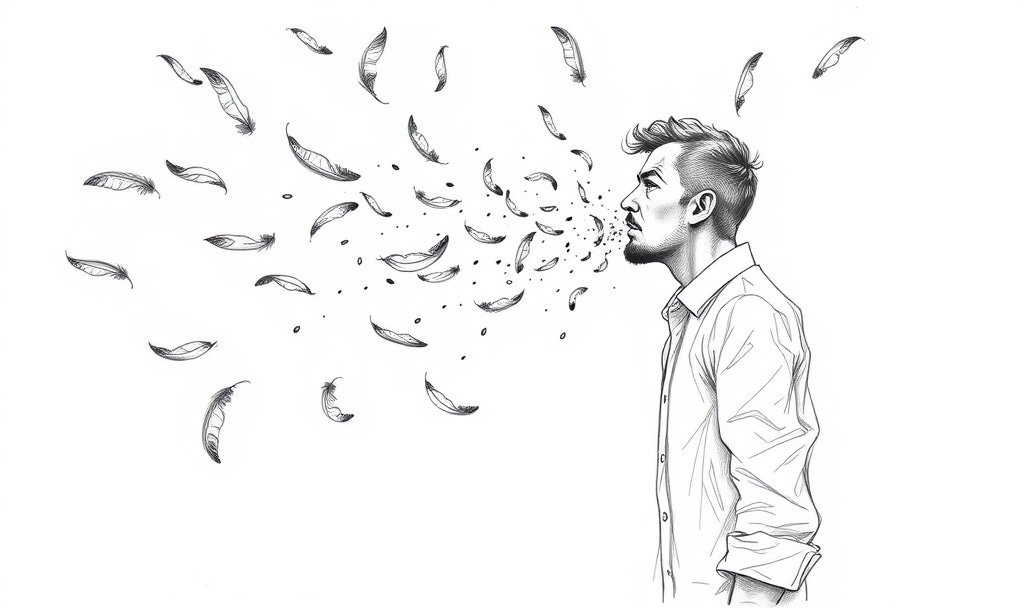
The range of speech, positive and negative, is limitless – as the Chassidic story reminds us, doing lashon hara is like opening a feather pillow outside on a windy day – and then trying to collect all the feathers. And what could be truer in our modern world of cyber-technology? The number of lives who are literally snuffed out by their own hand or that of another is so utterly dwarfed by the number of people who are irrevocably harmed each and every minute of each and every day. So much bile courses through the invisible wires that connect us, ricochets between satellites. One hundred forty years ago, Rabbi Yisrael Meir Kagan penned a book called Chafetz Chayim. Its chief purpose was to enumerate the laws of shemirat halashon, proper and improper speech. His analogy? That of a telegram. “Notice how carefully they consider each word before putting it down,” he writes. “That is how careful we must be when we speak.” Words have always been precious to Jews, but now even the printed word, the texted word, the reposted meme is cheap and oh so ubiquitous. How much more relevant it is in our day that nearly one quarter of the forty-three sins listed in Yom Kippur’s Al Chet prayer are sins committed through speech!
Each Shabbat, we offer a Mi Sheberach, a prayer for healing. We consider those whose lives have been turned upside down by illness, whose families have been absorbed in their suffering. This week’s parasha masquerades as a text about a fantastical disease, when in reality it is a powerful metaphor for an all too real condition. The world, which God lovingly created with speech, has become eroded by it. What is the best response? As with disease: refuah, healing. We shouldn’t be naïve, the cure for a pandemic isn’t simple as all of us learned far too well in 2020, but here’s one small place to start: Let’s speak a bit less and listen a bit more. The rabbis point out the human head has two ears and one mouth. Which do you think we’re supposed to use more? Do we get credit for holding our tongues or their proxy, our keystrokes? Usually not. Rabbi Harold Kushner writes, “Only God can give us credit for the angry words we did not speak.” But speech unmade is also sin undone. It’s not a bad place to start.


