


There are forces that want to bathe our joy in inescapable grief, as we learned on Oct. 7, Simchat Torah just 3 years ago. But there are other forces, better forces, Godly forces, that can be an antidote to the disease of hate.
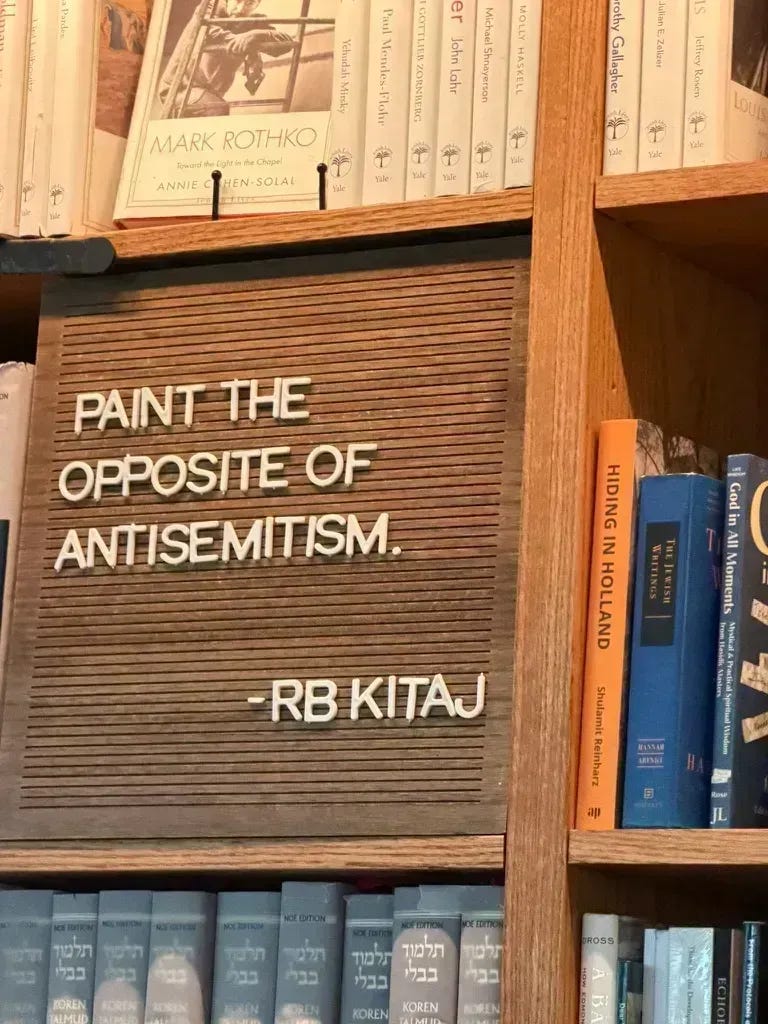
Miriam and Shamir were in Boston this past week and had the opportunity to visit Lehrhaus, the hipster mashup of restaurant, tavern, and beit midrash. A message board nestled amidst the books in Somerville features a quote from American Jewish painter R.B. Kitaj. It reads in all caps: PAINT THE OPPOSITE OF ANTISEMTISM. The hatred of our people is on a lot of our mind, I think. It’s in the news and on the tongues of prominent politicians. It’s coursing through our social media feeds. And certainly, it was a central message this week as many of us sat in our chapel to absorb the woeful words of Eicha on Tisha B’Av. Our burning Temples, pogroms, expulsions, inquisitions, the Shoah, October 7. The epigenetic weigh of Jewishness.
But this Shabbat is our annual escape hatch from that national Jewish day of Mourning. Shabbat Nachamu beckons us forth from grief, from the worst of our history, and the anxiety about the worst of our present circumstances, into an awareness of the many blessings surrounding us, and the possibilities of a brighter future. Today, this Shabbat, begins our march toward Rosh Hashanah, toward renewal and restoration.
My question for us is this: how might we paint the opposite of antisemitism? Or more specifically, how is Shabbat Nachamu an antidote to the pain of Tisha B’Av? As you may know, Tisha B’Av marked the conclusion of a period called bein hametzarim “between the straits,” the three weeks between the 17th of Tamuz and the 9th of Av. Shabbat Nachamu is the first of seven shabbatot of consolation, the shiva d’nechemta. So, three weeks, then seven weeks, after which we celebrate our New Year. But after those seven weeks, there are another three weeks, exactly 21 days between Rosh Hashanah and Hoshanah Rabbah during Sukkot, understood to be the real conclusion of High Holy Day season. Is there a relationship between the three weeks of mourning and these three weeks of introspection and, ultimately, joy?
The Hassidic masters believe there is. The Maor Vashamesh, Rabbi Kalonymus Kalman Epstein writes in the 19th century (Parashat Pinchas):
כ”א יום הם כנגד כ”א יום שבין ראש השנה עד הושענא רבה
“The 21 days correspond to one another.” How?
אלא שאלו בין המצרים הם בהעלם, ואלו הימים שמראש השנה עד הושענא רבה הם באתגליא
“The Three Weeks are in concealment, whereas the days from Rosh Hashanah through Hoshana Rabbah are revealed.” What might be revealed? The 20th century Slonimer Rebbe, the Netivot Shalom teaches that just as the Three Weeks are the root of sadness for the entire year – Sukkot is shoresh haSimcha, the root of joy. He draws on an earlier tradition from the original Rabbi Abraham Joshua Heschel, the late 18th century Apter Rebbe, who taught that the 21 days we just completed in Av and those 21 days of the fall chagim correspond to yet another 21 days: the eretz yisraeli Biblical festivals throughout the Jewish year. Shabbat counts as 1, Rosh Hodesh 1, Pesach 7, Shavuot 1, Rosh Hashanah 2, Yom Kippur 1, Sukkot 8 = 21.
All of this is to say that this moment in our calendar holds great potentiality, is pregnant with possibility. In a world filled with too much hate, bullies and their cheap words, despots and their costly actions, mobs and their terror, our tradition holds secrets for healing and wholeness. And this Shabbat, as we step from three weeks of pain into seven weeks of comfort, can ignite within us, if we let it, a force to carry us toward those fall holidays and into the New Year beyond. I want to suggest that shabbat Nachamu plays a catalytic role. How is this is a shabbat of love? Sadness may be the waters that have surrounded us. Joy is the ultimate destination, a wellspring of flourishing. But love propels us across the surface of those waters. It is the antidote to Tisha B’Av. “Hate cannot drive out hate,” wrote Dr. Martin Luther King, Jr., “only love can do that.”
So, it’s no coincidence that this Shabbat Nachamu is always Parashat V’Etchanan. And V’Etchanan contains not only the Ten Commandments but Shema and V’Ahavta. “You shall love the Lord your God, b’chol levavcha, with all your heart, b’chol nafshecha, with all your being, u’vechol meodecha, with all your substance” (Deu 6:5). Eicha! “How,” asked Parashat Devarim (1:12) and the book of Lamentations? “Ahavah, Love,” answers V’Etchanan.
But you might ask, isn’t V’ahavta about loving God? How is loving the Holy One meant to increase love in our world, in our lives? The poet Marge Piercy has a response, and one rooted in the best of our tradition:
So you shall love what is holy
with all your courage, with all your passion
with all your strength.
[…]We should love ourselves, for we are of G-d.
We should love our neighbors as ourselves
We should love the stranger, for we
were once strangers in the land of Egypt
and have been strangers in all the lands of the world since.
Let love fill our hearts with its clear precious water.
[…]We must choose life so our children’s children may live.
Be quiet and listen to the still small
voice within that speaks in love.
Open to that voice, hear it, heed it and work for life.
Let us remember and strive to be good.
Let us remember to find what is holy
within and without.
The cynic, or the skeptic, may hear these words and find them naïve. Love doesn’t win battles. Love doesn’t reach into the hearts of the truly intolerant and rescue them from their hate. There are battles worth fighting, of course. Words, despite the pacifist’s best intention, cannot stop a bullet or a prevent a genocide as our people have learned throughout the history we just commemorated on Tisha B’Av. But words do have a role, a critical role, in creating the conditions for fewer wars, less conflict, interrupted cycles of violence.
When Louis Brandeis, the first Jewish Supreme Court Justice, wrote that the best remedy for hate speech is not enforced silence but “more speech,” he meant we should confront hate, admonish haters. But he also understood that societies who seek, first, to silence speech of one kind, especially with force, offer little protection against the silencing of dissenting voices of any kind. Those are societies without a free press, the right to peaceably assemble, the permission to protest. Shabbat Nachamu, out of the ashes of our suffering, offers us a counterpoint to our baser instincts—the possibility of connection, of compassion, of love.
Anyone listen to the Hartman Institute’s Identity/Crisis Podcast? There was an episode recently in which Yehuda Kurtzer interviewed Shaanan Streett, the Israeli hiphop artist and frontman for Hadag Nachash. Streett and Kurtzer were discussing the popular rap “Harbu Darbu,” the rage and hate-filled song by Ness and Stilla which became wildly popular in the months after October 7. Streett explained that he had met the duo, even performed with them. “They’re not crazy fascists,” he said. “They’re just ordinary Israelis that were swept in the moment…very humiliated, very angry. And that was their artistic response.”
Streett’s response, though, was different. He felt, beyond the battles, after the war, the only lasting way forward was the path of attempted understanding. So he recorded his own song titled “Chabru Dabru.” “Harbu Darbu means ‘destroy and hit’ in Arabic, he said, ‘but my song, you change around the letters and it becomes ‘connect and speak.’” That is a path of love.
“Paint the opposite of Antisemitism.” In my pre-Shabbat video, I mentioned Rabbi Abraham Isaac Kook and his teaching that the best response to sinat hinam, the baseless hatred which our Sages say caused the Temple’s destruction, is ahavat hinam. Free love. Not the Northern California kind of free love; boundless love, causeless love. Choosing to seek love when only hate seems possible.
The week after Tisha B’Av is all about love. The 9th of Av is a day of catastrophe. The Shabbat that follows is one of comfort when we read the directive, “love God” and learn through that how to love our fellow. And then comes the 15th of Av. What’s that? It’s Jewish Valentine’s Day. It’s our national day of love. Tu B’Av starts this Tuesday night. So, this week, let’s ask ourselves, how might we climb aboard that Love Boat, a vessel capable of carrying us across the waves of our sadness? What words might we choose when others tug at us from our fear and worry? Hevre, we have seven weeks to get ready for the next three. And then three weeks to prepare for Simchat Torah. There are forces that want to bathe our joy in inescapable grief, as we learned on that holiday just three years ago. But there are other forces, better forces, Godly forces that can be an antidote to the disease of hate. Love the Lord your God. The rest will follow.


